
Experimental Conditions
Differential Scanning Calorimetry (DSC)
Jump to a section
Pan materials
Pans are generally made of aluminum and are comprised of a pan base and lid. The base is the same for most pans, but lids can differ based on sample types or DSC experimental needs. Knowing the type of pan base (basic or premium) and lid (standard, hermetic, or other) is vital as the reference pan must match the sample pan.
Non-aluminum pans may be useful for higher internal pressure ratings (> 2 atm from aluminum hermetic pans), larger or smaller sample volumes (amounts), if the sample reacts with aluminum, and/or for high temperature (> 600 °C) experiments. These pans, sample and reference, must be provided by the user.
Pans need to be well sealed prior to and throughout the DSC experiment. The pan bottom should be flat and even (no bending or deformation). The lid should be welded to the pan bottom without holes or leakages. If the pan is leaking, discolored, or shows any residue on the pan or in the cell, the pan was not sealed appropriately (please see the User Portal for more information on how to proceed). If a pan has unexpectedly leaked during the experiment, contact the Lab Manager immediately so that cell cleaning can be performed. Often, pan leakages are the result of improper sealing (see Sealing a Pan or the User Portal for more information on properly sealing a sample pan) or using the incorrect pan for the desired DSC experiment.
Pan Base
There are 2 main pan bases often used: basic or premium. As the names suggest, these pan differences are primarily cost differences due to more stringent tolerances. We use two main DSC pan suppliers—TA Instruments and DSC Consumables. Each supplier uses a slightly different name for the same pan base.
- Basic/TA: nominal crafting tolerances for aluminum DSC pans.
- Premium/Tzero: crafted with tighter material and casting tolerances for better heat transfer and smaller mass differences between pans.
Basic pans are the more common pan base. DSC Consumables calls basic pans “Basic” pans. TA Instruments calls basic pans “TA” pans. Basic aluminum pans are cheaper and created under lower purity and mass tolerances. The biggest trade-off with basic pans is finding pan sets of similar mass. Reference and sample pans prepared with basic pans will often have dissimilar pan masses (ca. +/- 1 mg), which can increase thermal noise.
Premium pans are necessary for specialized experiments where high sensitivity is imperative, such as heat capacity measurements. DSC Consumables calls premium pans “Premium” pans. TA Instruments calls premium pans “Tzero” pans. Premium aluminum pans are more expensive but have tighter purity and mass tolerances. Theoretically, tighter design specifications yields improved resolution, greater sensitivity, and better reproducibility compared to basic pans.
Pan Lid
Pan lid types depend on the sample material and generally refer to the pan-lid sealing tightness. There are two common lids types—standard and hermetic—as well as a specialty lid, pin-hole, that is useful for specialized experiments.
- Standard: solids and non-volatile sample materials.
- Hermetic: liquid or volatile sample materials. These lids are required for any samples showing >0.5% weight loss throughout the requested DSC temperature range (determined by TGA analysis prior to DSC acquisition).
- Pin-hole: boiling point or vapor pressure measurements.
Standard pan lids are appropriate for most DSC applications, but have weaker cold welding seals. DSC experiments should be performed over thermally stable temperatures. For most solid materials, there should be no active decomposition and, thus, no internal pressure increases that would strain the pan seal.
Hermetic pan lids are designed for liquid or volatile samples. However, these are also safe pans for most DSC applications, in case some sample decomposition occurs during the analysis. These pans are designed for stronger cold weld sealing so that sample volatiles remain contained in the pan. These pans will generally hold 2-3 atm internal pressure. For safety sake, hermetic pan lids are default for most internal projects.
Pin-hole lids can be purchased as pre-punched lids or can be created from a hermetic pan lid. Machined pin-hole lids are more uniform and reproducible; however, pin-hole lids can be created from hermetic lids using a push-pin to manually punch a hole approximately lid center. Generally, DSC lids are designed to retain all sample (including volatiles), but some experiments require venting. For example, the pin-hole lid allows safe pressure relief of water while still retaining most containing the sample (protecting the cell and sensors) and trapping a local atmosphere for more realistic boiling or vaporization conditions. Pin-hole lids should only be used with the express permission of the Lab Manager and cell cleaning may be performed following your experiment.
Reference Pan
A reference of an empty, sealed pan, matching the same sample pan type is necessary. If using a standard aluminum sample pan, an empty standard aluminum pan should be used as the reference. If using a premium hermetic sample pan, an empty premium hermetic aluminum pan should be used as the reference. For absolute best results, reference and sample pans should be within 0.5 mg.
Sample amounts
Sample amounts are dependent on composition and/or experimental needs. Typical amounts are 5 – 10 mg. In general, larger sample sizes are needed for slower heating rates (< 10 °C/min) and smaller sample sizes are needed for faster heating rates (~20 °C/min).
Start with sample amounts between 2 – 6 mg. If your sample is known or suspected to thermally react (e.g., thermally expand), use less sample. Increase sample mass to ~10 mg if desired transitions are weak. Sample >10 mg should be avoided. If desired transitions are still weak, consider a modulated experiment (i.e., mDSC).
| Organic | 2 – 10 mg |
| Inorganic | 5 – 50 mg |
| Strongly exothermic | < 5 mg |
| Purity or kinetics | 1 – 5 mg |
| Metal or Chemical melting point | < 5 mg |
| Polymer glass transitions or melting point | ~ 10 mg |
| Composite or blend | > 10 mg |
| Heat cpaacity | ~ 10 mg |
| Modulation (mDSC) | 2 – 10 mg |
Sample materials
Solids and film materials are preferred, but liquids and other solid forms are applicable. Samples should be representative of the bulk material. Mixing or composite methods should be applied to ensure bulk similarity to the analyzed sample.
The sample should be thermally stable throughout the DSC temperature range. To ensure the sample is not actively decomposing during the DSC experiment, a TGA analysis is required before running the sample by DSC. From the TGA, acquire the T95 temperature (i.e., the temperature at which < 5% of the sample has decomposed). The maximum DSC temperature should be set at T95 – 10 °C (i.e., 10 °C before the sample’s T95). NO DSC measurements should be conducted above the sample’s T95.
Good DSC measurements rely on good thermal contact at all contact points–cell pestle-pan bottom, pan bottom-sample, and sample-pan lid/top. To minimize the thermal gradient within the sample and pan, ensure (1) a flat, non-deformed pan bottom, (2) packed or flat sample, (3) orient the lid for best thermal contact with the sample (i.e., TA Instrument’s pans are designed to be sealed concave or “bump” up, away from the sample), and (4) only half fill a pan with sample. Use these suggestions depending on your specific sample type for best results:
- Cut the material if possible. Crushing the sample is not recommended.
- Cover as much of the pan bottom as possible.
- To achieve good heat transfer between the sample and pan, the sample should have one surface with an area as smooth as possible that allows the sample to lie flat on the pan bottom.
- Compacting powdered or fibrous material may be necessary to ensure the sample height is not too great.
- The pan bottom should be flat. Deformation of the pan will introduce a thermal gradient within the sample that will negatively impact the data.
- If analyzing a metal, a high temperature ramp should be performed initially to first melt the sample.
- Do not overfill a pan as this may cause the sample to leak out, buckle the seal, or explode the pan. Only fill the pan approximately half. If your sample is known or thought to thermally expand, fill less.
For detailed DSC sample preparation instructions, visit the Sample Preparation page in the User Portal.

Sealing a pan
Cold welding is used to seal sample pans. The seal can be achieved using an available sample press. There are two sample presses available. Some instruction on the sample press use is provided below, but detailed instructions on can be found in the User Portal. Neither press requires force to achieve a good seal. In fact, applying force—either by slamming the handle down and/or excessively pressing the handle down—can negatively impact the seal. Applying excessive force during sealing can actually cut into the pan, creating an invisible seam through which the sample can leak, instead of creating a pressure-safe seal.
General pan press
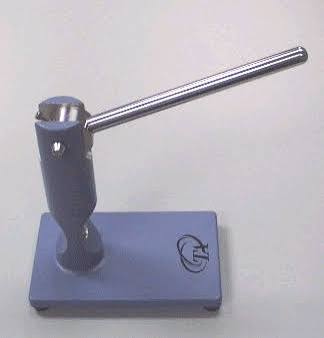
This pan press uses a general, internal die set that is applicable to any pan type. The bottom pan with sample is placed into the bottom die cavity and the pan lid is manually aligned on top of the pan bottom. A separate alignment tool is fitted on top of the assembled pan to help center the lid onto the pan bottom. The handle pushes the top die into the pan to create the seal. The handle should only be pulled to approximately shoulder height, not completely down. The handle does not require any downward speed and/or downward force to create a good seal. Lifting the handle allows access to the sealed pan. The pan can be lifted out of the bottom die cavity using tweezers.
Die set sample press
This sample press uses exchangeable die sets that should be matched to the pan type. Die sets come is pairs with 1 or 2 top dies and 1 bottom die. All dies in the set are color coded according to the pan type (see table below). All dies magnetically fit into the sample press for easy alignment. An assembled pan, bottom pan with sample and its correctly oriented lid, is placed in the bottom die set.
The bottom die with sample and pan are then fitted into the bottom area of the sample press. Some die sets have 2 top dies that depend on sample material and/or shape. Some die sets have 2 top dies that should be used sequentially. Some dies sets only have 1 top die. An appropriate top die is then loaded into the top area of the sample press.
The handle is pulled down to the lever stop position. The handle does not require any downward speed and/or downward force to create a good seal. Excess force can damage both the pan and the die sets. Lifting the handle allows access to the sealed pan. Remove the top die first for easier access to the bottom die. The bottom dies are hollow and can be fitted on the front pedestal to easily remove the sealed pan from the bottom die. The flat pedestal also allows easy inspection of the pan to ensure both a good seal and appropriately prepared sample.

| Die color | Pan type |
| Green die set 2 top dies (flat or bulky material) & 1 bottom die | Basic, standard aluminum pans |
| Black die set 2 top dies (flat or bulky material) & 1 bottom die | Premium, standard aluminum pans |
| White die set 2 top dies (sequential use) & 1 bottom die | Basic, hermetic aluminum pans |
| Blue die set 1 top die & 1 bottom die | Premium, hermetic aluminum pans |
Modulation (mDSC)
If sample amounts are limited or transitions are small. Some applications include:
- complex transitions, involving multiple processes
- limited sensitivity
- limited resolution
- heat capacity
- thermal conductivity
Heat Capacity
Measurements are generally slower and over shorter temperature ranges. Heat capacity measurements are acquired in comparison to a sapphire (preferred) or polystyrene standard, acquired under the same conditions and method as the sample. Calibration for these experiments are short-lived and should be performed within the day (preferred) of sample acquisition/measurements. A sample mass of ~10 mg is highly recommended for best results. There are 3 methods for acquiring heat capacity data, in increasing accuracy:
- Direct Cp (fastest) – A single sample Cp acquisition after a single sapphire Cp calibration. Several samples can be acquired within the day of calibration, without any additional sapphire calibration. Pans must be premium (Tzero) hermetic.
- Three run Cp/ASTM method (traditional) – Cp data is acquired as a set of 3 runs: baseline, sapphire, and sample run. Pan type (premium/Tzero hermetic) and mass (53.9 mg) must be identical for all 4 pans: reference, baseline sample, sapphire, and sample. No additional calibration is required, as all samples contain their own calibration from the baseline and sapphire runs acquired immediately before the sample run.
- Modulated Cp (most accurate) – Sample Cp acquisition following a reversing (via mDSC) sapphire Cp calibration. mDSC measurements are slow (< 3 °C/min), so a very narrow temperature ramp is recommended. Several samples can be acquired within 1-2 days of calibration, without any additional sapphire calibration. Pans must be premium (Tzero) hermetic.
Special considerations or experiments
For any of these experiments, please contact the Lab Manager directly to discuss specific experimental and sample preparation requirements as well as coordinate instrumentation time.
- Temperature sensitive experiments – pans are typically loaded at 40 °C; however, for some temperature sensitive samples, loading temperatures can be lowered to 20 °C, upon request. For these experiments, samples are recommended to be prepared and crimped (pan) in a refrigerated environment. Prepared samples should be stored cold until ready for analysis.
- Alternate atmosphere analysis – DSC cell is purged and acquired in nitrogen. Alternate acquisition gases (helium, nitrogen, air, argon) may be used upon request, or multiple gases may be introduced (2 gas maximum) during the experiment. For these experiments, unsealed pans (sample and reference) may be used.